
What is Overload Relay?
Overload relays provide reliable motor overload protection by preventing damage caused by phase failure, high temperatures, or electrical overload. They’re usually connected in series to the contactor (or switching device) to protect the motor from problems associated with the motor drawing excess current that could lead to overheating and damage to windings. When operations depend on the safe and efficient function of a motor, it’s essential to keep it protected from as many potential sources of damage as possible.
Advantages of Overload Relay
Higher accuracy
Thermal overload relays incorporate bimetallic technology and an electromechanical design, giving them higher accuracy.
Cost-effectiveness
Thermal overload relays have a straightforward and simple design which contributes to their cost-effectiveness. They are also cheaper than circuit breakers.
Ability to handle higher temperatures
Thermal overload relays are able to deal with higher temperatures due to their use of bimetallic strips.
Adjustable safety settings
Thermal overload relays enable adjustment of the current range to match the specific operational needs and characteristics of motors.
Ease of operation
It is relatively easy to operate thermal overload relays mainly due to their simple design and adjustable settings.
-

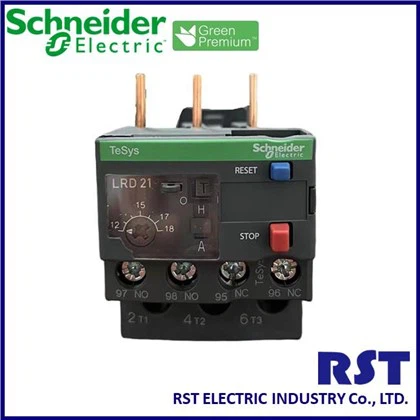
Schneider Overload Relay LRD21
Place of Origin: Thailand. Brand Name: Schneider. Model Number: LRD21. Theory: Relay Add to Inquiry -
Schneider Overload Relay LRD08
Motor overload relays are specifically designed for protecting electric motors. They typically integrate overload protection with other motor control functions, such as motor starters or contactors. Add to Inquiry -
Schneider Overload Relay LRD08
Place of Origin: Thailand. Brand Name: Schneider. Model Number: LRD08. Theory: Relay Add to Inquiry -
Schneider Overload Relay LRD10
Place of Origin: France. Brand Name: Schneider. Model Number: LRD10. Theory: Thermal Relay Add to Inquiry -
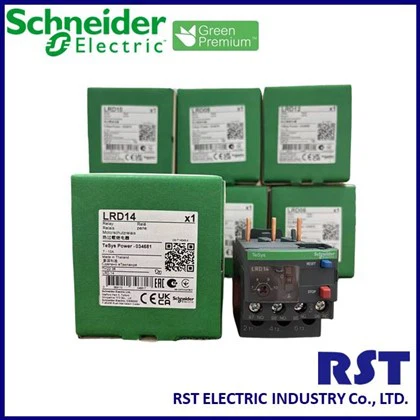
Schneider Overload Relay LRD14
Place of Origin: Thailand. Brand Name: Schneider. Model Number: LRD14. Theory: Relay Add to Inquiry -
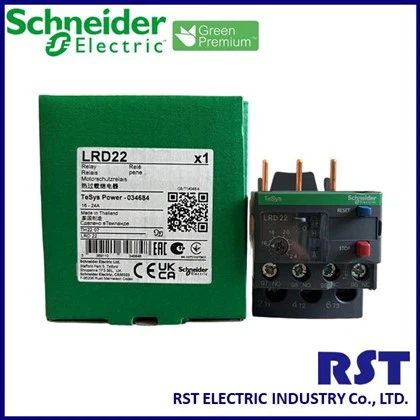
Schneider Overload Relay LRD22
Place of Origin: Thailand. Brand Name: Schneider. Model Number: LRD22. Theory: Thermal Relay Add to Inquiry



Why Choose Us
Experienced
With 30 years' experience, RST has dedicated to provide total solution of Industrial Facilities, Business or Residential Buildings distributing energy saving, providing customers complete after sales consultation of one stop shopping, national operation and local service.
Quality
Our team takes great pride in delivering high-quality products and services to our clients. We strive to exceed expectations and always put our customers first. With electrical power resources as the core of development, we offer total solution to our clients, becoming their trustworthy partners.
Wide selection
We service and sell all major manufacturers so you aren't limited to any one brand, make or model. We are a main distributor of Schneider products, Merlin Gerin products, Telemecanique products, RTR Capacitors, ETI Power Fuses, VEI LBS, AREVA LBS, Shihlin Electric products, Mitsubish products, Delta products, Mean Well products and Sunon AC/DC Fans.
24/7 availability
No matter the time of day or night you call, you'll get the same prompt, cheerful service.

Types of Overload Relay
Thermal overload relays
These relays use a bimetallic strip or heater element that heats up and trips the relay when the current exceeds the set value.
They provide protection against sustained overload conditions and are commonly used in motor control circuits.
Magnetic overload relays
These relays use an electromagnetically operated mechanism to trip the relay when the current exceeds the set value.
They provide faster response times compared to thermal overload relays and are better suited for protecting against short-circuit conditions.
Electronic overload relays
These relays use electronic circuitry to monitor the current and trip the relay when the current exceeds the set value.
They offer more precise and adjustable overload protection, as well as additional features like adjustable trip times and current monitoring capabilities.
Solid-state overload relays
These relays use solid-state components, such as semiconductors, to monitor the current and trip the relay when the current exceeds the set value.
They provide fast and accurate overload protection, and can offer additional features like current display, adjustable trip times, and communication capabilities.
Working Principle of Overload Relay
A overload relay works in the principle of electro-thermal properties in a bimetallic strip. It is placed in the motor circuit in such a way that the current to the motor flows through its poles. The bimetallic strip gets heated up by the current directly or indirectly and when the current flow exceeds the set value, it bends.
They always work in combination with contactors. When the bimetallic strips heat up, the trip contact is activated that in turn breaks the power supply to the contactor coil, de-energizing it and breaking the current flow to the motor. This tripping time is always inversely proportional to the current flow through the olr. Hence higher the current flow faster shall it trips. Therefore, overload relay are referred to as current-dependent and inversely time-delayed relays.
How to Choose Overload Relay
Determine the motor full-load current
The first step is to find out the full-load current (flc) of the motor, which is the current that the motor draws when it operates at its rated power and speed. The flc is usually given on the nameplate of the motor, or it can be calculated from the motor voltage, power, and power factor. The flc is the basis for selecting the overload protection device, as it represents the normal operating current of the motor.
Choose the overload protection device
The second step is to choose the type of overload protection device that suits your motor and your application. There are two main types of overload protection devices: Thermal and magnetic. Thermal overload protection devices use a bimetallic strip or a heater and a melting alloy to sense the temperature rise of the motor or the circuit, and open the circuit when the temperature exceeds a preset limit. Magnetic overload protection devices use an electromagnet to sense the current flow in the circuit, and open the circuit when the current exceeds a preset limit. Thermal overload protection devices are more common and more suitable for motors that have a high inertia or a high starting current, as they allow for a temporary overload without tripping. Magnetic overload protection devices are more responsive and more suitable for motors that have a low inertia or a low starting current, as they provide faster protection against short circuits or ground faults.
Size the overload protection device
The third step is to size the overload protection device according to the flc of the motor and the applicable safety standards. The size of the overload protection device is expressed as a percentage of the flc, and it determines the maximum current that the device will allow before tripping. The size of the overload protection device should be large enough to avoid nuisance tripping due to normal variations in the motor current, but small enough to provide adequate protection against overload conditions. The safety standards, such as the national electrical code (nec) or the international electrotechnical commission (iec), provide guidelines for sizing the overload protection device based on the motor type, the service factor, the ambient temperature, and the load type. For example, according to the nec, a thermal overload protection device for a continuous-duty motor with a service factor of 1.15 should be sized between 115% and 125% of the flc, while a magnetic overload protection device for the same motor should be sized between 250% and 300% of the flc.
Adjust the overload protection device
The final step is to adjust the overload protection device to match the actual operating conditions of the motor and the load. The adjustment can be done by changing the trip setting, the heater rating, or the time delay of the device, depending on the type and the model of the device. The adjustment should be done carefully and with proper testing, as it affects the sensitivity and the reliability of the device. The adjustment should account for factors such as the motor efficiency, the load variation, the voltage variation, the frequency variation, and the altitude. The goal of the adjustment is to optimize the performance and the protection of the motor and the circuit, without compromising the safety and the compliance of the system.
Application of Overload Relay
Industrial machinery
Thermal overload relays are widely used in industrial machinery such as pumps, fans, conveyors, and compressors to protect the motors driving these machines.
Hvac systems
Heating, ventilation, and air conditioning (hvac) systems rely on thermal overload relays to protect the motors powering the blowers, fans, and compressors.
Manufacturing processes
From manufacturing assembly lines to robotic systems, thermal overload relays ensure the protection and smooth operation of motors used in various manufacturing processes.
Commercial buildings
In commercial buildings, thermal overload relays are used to protect motors in elevators, escalators, ventilation systems, and other motor-driven equipment.
How to Test Overload Relay
Overload relay test button
This is the simplest testing method. The overload relay test button (or switch) is located on the front of the relay. It essentially simulates an overload situation by opening the nc contacts and closing the no contacts. Note that you’ll need a multimeter for this process. Here are the steps.
Locate the test button or switch on the relay.
Set the multimeter so it reads resistance in ohms.
Connect multimeter leads to the 95 and 96 terminals of the relay: It should read continuity
With the multimeter probes still connected to the 95 and 96 contacts, press or slide the test button to simulate a trip.
This will open the nc relay contacts and close the no contacts. The multimeter should also now read 0 to show continuity.
Reset the unit by pushing the reset button.
Overload relay testing kit
A overload relay testing kit is a sophisticated machine that tests the relay’s operation and tripping accuracy, among other parameters. It works by injecting a very high (but controlled) current into the relay to simulate a situation where the relay should trip. Here’s how it’s used.
Turn off all power sources to the relay and disconnect it from its circuitry.
Connect the thermal relay testing kit as per the user manual instructions, making sure that all the terminals are properly connected.
Turn on the power in a few seconds; you should see readings for both current and voltage displayed on the tester’s screen.
Make sure the tested parameters are within the recommended values.
The results of the test will help you determine if the relay is operating properly or not and if it needs replacing.
Overload Relay Maintenance
● The installation direction of overload relay must be the same as that specified in the product manual, and the error shall not exceed 5°.When the overload relay is installed together with other electrical appliances, it should prevent the heating of other electrical appliances.Cover the heat relay.
● Check whether the rated current value of the overload relay thermal element, or the scale value of the current adjustment knob, is equal to the rated current value of the motor.If not equal, replace the heat element, or turn the scale of the adjustment knob to comply.Usually, the rated current value of the overload relay is slightly higher than that of the motor.If the overload relay and the motor are installed in two places respectively, and the ambient temperature of the two places is quite different, then the current value of the two should be different.For example, jr1 and jr2 seriesoverload relay have no temperature compensation. When the ambient temperature of the overload relay is lower than the ambient temperature of 15~20°c of the motor, the rated current value of the overload relay thermal element can be 10% smaller than the rated current value of the motor, so a smaller thermal element can be selected.On the contrary, the rated current value of the thermal element is 10% larger than the rated current value of the motor, and a larger thermal element can be selected.
● Overload relay in use, need to regularly wipe with cloth dust and dirt, bimetal pieces should keep luster, if there is rust, can use cloth dipped in gasoline gently wipe, but do not use sandpaper grinding.
● The action mechanism should be normal and reliable, can be pulled for four to five times of observation, reset button should be flexible, adjust parts, not loose, if loose, should be tightened to browse more content, please log in and adjust again.When checking and adjusting parts, only gently touch with hand or screwdriver, not twisting or pushing.For the adjustable overload relay, check the scale for the desired scale value.
● The overload relay wiring screws should be tightened, the contacts must be well touched, and the cover should be well covered.
● When checking whether the thermal element is good, you can only open the lid to observe from the side, and do not remove the thermal element.If it must be removed, power on test adjustment after installation.
● During use, power verification shall be verified once a year.In addition, after the equipment accident, and cause a huge short circuit current, the thermal element and bimetal sheet should be checked, whether there is obvious deformation.If the obvious deformation has been produced, need to power test adjustment, adjustment, absolutely can not bend bimetal sheet.
Overload Relay Setting and Calculation
Overload relay is the one of important device for motor control.It can prevent our motor from overheat or winding burning due overload of ampere.
We need to setting the value of overload relay properly depend on our application and motor full load ampere.If we setting low from fla,it can cause motor trip c0ntinues and process not running smoothly.
But if we setting to high from fla,the overload relay cannot protect the motor if overload happen.It can cause the motor failure or winding burns.So we must calculated and get a right setting for the overload relay.
How to setting overload relay protection?
Basically to setting the overload value,we refer to this formula :
1) ib ≤ in ≤ iz
Ib = anticipated operating current of the circuit
Iz = current carrying capacity of conductor or cable or motor
In = rated current of protective device
2) i2 ≤ 1,45 x iz
Note:
Iz = current carrying capacity of conductor or cable or motor
For adjustable protective devices, in corresponds to the value set.
I2 = the current which causes tripping of the protective device under the conditions specified in the equipment regulations (high test current).
Common practice
Normally for overload relay setting depend on fla ( full load ampere ) of motor.We can see at the nameplate of motor.Normally setting for overload is 5% until 10 % more than fla.
But it is depend on operation and functional of motor.For more detail setting,please refer manual guide of motor from manufacture.
We also can setting overload relay value depend on value of service factor motor.Example if service factor 1.15,we can setting 125% from fla and if service factor is 1.0,we can setting 115% from fla of motor.
Manual and automatic reset.
Normally,overload relay have this 2 reset function selection.We can choose manual or automatic reset after it trigger overload from motor.
I recommended for manual reset function because we can know when it trip and we can troubleshooting the root cause for tripping issue.So after we found the root cause,we can reset back the overload relay and can continue the operation.
Video
FAQ
As one of the most professional overload relay suppliers, we warmly welcome you to buy original overload relay in stock here from our factory. All our products are with high quality and competitive price. For more information, contact us now.
best 7 3 glow plug relay, deek robot timer relay, 24v wifi relay