
What is Schneider Ac Contactor?
An schneider ac contactor is an electromechanical switching device designed to switch ac loads on/off. It is used for switching high-current ac loads.Schneider ac contactor have a crucial role in electrical circuit systems. It helps in the effective control and management of electricity flow across various high-current demanding loads. It is widely used in operating hvac, compressors, heavy-duty motors, and similar others.
Advantages of Schneider Ac Contactor
Self-locking mechanism
The schneider ac contactor uses a self-locking mechanism that keeps the contacts closed even after the electromagnetic field is deactivated. This feature ensures that current flows continuously and eliminates the need for constant power to hold the contacts in place. It also reduces power consumption and improves the overall reliability of the control system.
Durability and lifespan
Schneider ac contactor are designed to withstand frequent switching operations and harsh electrical environments. They are made from sturdy materials and advanced engineering for exceptional durability and longevity. This reliability reduces maintenance costs and increases system uptime, making schneider ac contactor the first choice for critical applications.
Switching frequency
One of the key functions of an schneider ac contactor is its ability to open and close electrical wires frequently and reliably. Unlike manual opening and closing circuits, schneider ac contactor operate using an electromagnetic field pull-in mechanism. This feature ensures greater efficiency and flexibility, allowing the contactor to meet the needs of complex electrical systems.
Large current control
Schneider ac contactor have the unique ability to control large current loads with small currents. This attribute makes them indispensable when handling heavy electrical equipment in a variety of industrial, commercial and residential environments. Schneider ac contactor prevent equipment damage and the risk of electrical failures by effectively controlling current, ensuring the safe operation of connected equipment.
-

Schneider Contactor LC1D09M7
Brand Name: Schneider. Product Name: Contactor. Type: LC1D09M7. Electricity Type: AC. Lead Time: in stock. Shipping Method: DHL/ TNT/ FEDEX/ AIR/ OCEAN. Payment Method: Wire Transfer/ West Union/ Add to Inquiry -
Schneider Electric Contactor LC1D18B7
Large lighting installations, such as an office building or a retail store, are frequently controlled by contactors. Latching contactors, which contain two functioning coils, are used to reduce power Add to Inquiry -
Schneider Contactor LC1D09M7
The readings on the volt-ohmmeter should generate the same reading of 0 ohms and direct short. If it does not, check if the coils are properly linked or try to cycle the control switch of the coil if Add to Inquiry -
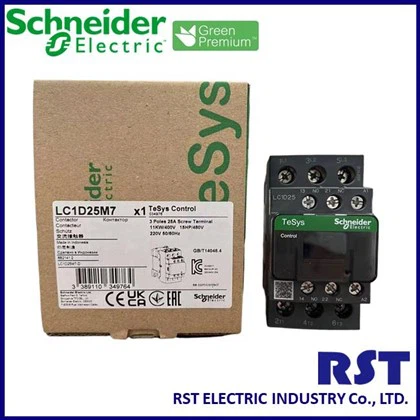
Schneider ac Contactor LC1D25M7
Brand Name: Schneider. Product Name: Contactor. Type: LC1D25M7. Electricity Type: AC. Lead Time: in stock. Shipping Method: DHL/ TNT/ FEDEX/ AIR/ OCEAN. Payment Method: Wire Transfer/ West Union/ Add to Inquiry -
Schneider ac Contactor LC1D80M7
Brand Name: Schneider. Product Name: Contactor. Type: LC1D80M7. Electricity Type: AC. Lead Time: in stock. Shipping Method: DHL/ TNT/ FEDEX/ AIR/ OCEAN. Payment Method: Wire Transfer/ West Union/ Add to Inquiry -
Schneider Magnetic Contactor LC1D95M7
Brand Name: Schneider. Product Name: Contactor. Type: LC1D95M7. Electricity Type: AC. Lead Time: in stock. Shipping Method: DHL/ TNT/ FEDEX/ AIR/ OCEAN. Payment Method: Wire Transfer/ West Union/ Add to Inquiry -
Schneider TeSys D Contactor LC1D115M7
Brand Name: Schneider. Product Name: Contactor. Type: LC1D115M7. Electricity Type: AC. Lead Time: in stock. Shipping Method: DHL/ TNT/ FEDEX/ AIR/ OCEAN. Payment Method: Wire Transfer/ West Union/ Add to Inquiry -
Schneider Contactor LC1D150M7
Brand Name: Schneider. Product Name: Contactor. Type: LC1D150M7. Electricity Type: AC. Lead Time: in stock. Shipping Method: DHL/ TNT/ FEDEX/ AIR/ OCEAN. Payment Method: Wire Transfer/ West Union/ Add to Inquiry -
Schneider Electric Contactor LC1D18B7
LC1C18B7. Brand Name: Schneider. Product Name: Contactor. Type: LC1D18B7. Electricity Type: AC. Lead Time: in stock. Shipping Method: DHL/ TNT/ FEDEX/ AIR/ OCEAN. Payment Method: Wire Transfer/ West Add to Inquiry




Why Choose Us
Experienced
With 30 years' experience, RST has dedicated to provide total solution of Industrial Facilities, Business or Residential Buildings distributing energy saving, providing customers complete after sales consultation of one stop shopping, national operation and local service.
Quality
Our team takes great pride in delivering high-quality products and services to our clients. We strive to exceed expectations and always put our customers first. With electrical power resources as the core of development, we offer total solution to our clients, becoming their trustworthy partners.
Wide selection
We service and sell all major manufacturers so you aren't limited to any one brand, make or model. We are a main distributor of Schneider products, Merlin Gerin products, Telemecanique products, RTR Capacitors, ETI Power Fuses, VEI LBS, AREVA LBS, Shihlin Electric products, Mitsubish products, Delta products, Mean Well products and Sunon AC/DC Fans.
24/7 availability
No matter the time of day or night you call, you'll get the same prompt, cheerful service.

Working Principle of Schneider Ac Contactor
When the coil is energized, the static iron core generates electromagnetic attraction, which attracts the moving iron core. Since the contact system is linked with the moving iron core, the moving iron core drives the three moving contact pieces to move at the same time, and the main contact is closed, and the main contact is closed. The auxiliary normally closed contact mechanically connected to the contact is disconnected, and the auxiliary normally open contact is closed, thereby turning on the power supply. When the coil is de-energized, the suction force disappears, and the moving iron core linkage part is separated by the reaction force of the spring, so that the main contact is disconnected, the auxiliary normally closed contact mechanically connected to the main contact is closed, and the auxiliary normally open contact is disconnected , thereby cutting off the power.
● Generally, a three-phase contactor has a total of 8 points, three inputs, three outputs, and two control points. The output and input correspond, which is easy to see. If you want to add self-locking, you also need to connect the wire from a terminal of the output point to the control point.
● First of all, you should know the principle of ac contactor. He uses an external power source to add an electromagnetic field to the coil. When the power is turned on, the contact point will be disconnected after the power is turned off. After knowing the principle, you should figure out the contacts of the external power supply, that is, the two contacts of the coil, which are generally on the lower part of the contactor and on each side. The other inputs and outputs are generally on the upper part, which can be known at a glance. Also pay attention to the voltage of the external power supply (220v or 380v), which is generally marked with. And pay attention to whether the contact point is normally closed or normally open. If there is self-locking control, just sort out the circuit according to the principle.
The carrying current of the ac contactor is very large. Generally, the internal pull-in coil is used to control its action. The control coil is operated by various types of relays connected in series with it. The trip will be caused by the ac after a lightning strike. The relay of the contactor has an overcurrent or grounding protection function. When there is lightning on the line, it will control the action of the ac contactor and cut off the load power to protect the equipment from high voltage, high current damage or grounding safety hazards.
Components of Schneider Ac Contactor
Contact support assembly: Core component and functionality
This assembly forms the core of the ac contactor and includes the movable and fixed contacts that physically open and close the circuit. Precision manufacturing is crucial for long-life, reliable operations. The contacts must withstand high currents and millions of operations without degradation.
Base assembly: Structural foundation and integration
Acting as the structural foundation, the base assembly houses the electrical components securely and allows integration with external control circuits via terminals. Robust insulating materials isolate live parts for operator safety.
Coil and screw tightening: Ensuring secure connections
The electromagnetic coil allows for remote actuation via a control signal while tightening screws ensure durable connections between coil and base assembly.
Cover and contact plate: Protection and circuit control
These provide protective enclosures for the live contacts and other contactor parts and functions, with the contact plate facilitating the mounting of input/output terminals. Flame-retardant and chemically resistant materials shield operators from hazards.
Screw tightening and testing: Quality assurance measures
Strict quality control checks like automatic screw testing and contact resistance measurement happen to verify ac contactor integrity before shipment. Parameter tests confirm operational performance under simulated industrial conditions.
Key Factors to Consider When Selection an Schneider AC Contactor
Considering the widespread use of schneider ac contactor, there are now different varieties of schneider ac contactor available today. This makes it overwhelming to choose the best one that matches your needs.
To help ease this hassle, we have shortlisted a few key factors to consider when selecting an schneider ac contactor below:
Voltage rating
The voltage rating of the schneider ac contactor should be equal to the maximum voltage of the system it will operate in.
Current rating
The current rating should be higher than the system it will operate in. It should be able to handle the load current along with the initial inrush current during the start of the system.
Number of poles
Schneider ac contactor are mostly available in 3-pole and 4-pole versions. You can choose between them depending on the load type and control circuit requirements. For instance, 3-pole ac contactors are usable in three-phase systems, while 4-pole ac contactors can be used in 3 phase 4 wire system or 1 phase 2 wire system.
Lifespan
Make sure the product you use should have a prolonged lifespan. For that, you should consider the contactor’s mechanical and electrical life. The mechanical life refers to the number of switching cycles before wear affects performance. Similarly, electrical life refers to the number of operations under load. You should pick the contactor rated for millions of cycles.
Size and mounting
You should evaluate the location in the control panel where you want to place the schneider ac contactor. Afterward, pick the schneider ac contactorwhose size and mounting match your requirements.
Price and budget
A high-quality schneider ac contactor can be expensive but offers longer reliability. The recommended approach is to research the products of different manufacturers for your specific ratings and then pick the ones that are aligned with your budget.
Certifications
Make sure the schneider ac contactor holds credible certifications. Ce and ul are some important certifications to consider. You can find such information on the manufacturer’s product page.
Use and Application of Schneider AC Contactor
Use method of contactor
The correct use of contactor is very important to avoid damage to electrical equipment and help to improve the operating efficiency and safety of electrical equipment. The following points should be noted when using contactor:
● Contactor installation: The contactor shall be installed in a well-ventilated place, away from moisture, corrosive chemicals and other harmful substances. Pay attention to the correctness and firmness of cable connections during installation.
● Contactor selection: The contactor should be selected according to the electrical load power and electrical system voltage and other parameters. Too much will waste energy, too small will cause contactor failure.
● Contactor operation: Attention should be paid to the operation specification when using, do not excessive pressure, resulting in excessive wear of the contactor.
● Contactor maintenance: Regularly check whether the contactor connection is light and whether the contactor starts normally, so as to avoid short-circuit and other faults in the working process.
Applications of ac contactors in various areas
● Residential applications
In residential settings, ac contactors find application in various electrical devices, contributing to their safe and efficient operation. One primary area where contactors are used is in hvac (heating, ventilation, and air conditioning) systems. These systems utilize contactors to control the operation of compressors, fans, and other components. By engaging and disengaging the flow of electricity to the motorized elements, contactors ensure that the hvac system operates smoothly, maintaining desired temperatures inside the premises.
Ac contactors are widely used in refrigeration systems found in residential properties. These contactors allow for the control of the refrigerator's compressor, ensuring that it operates efficiently to maintain a consistent, cool temperature required to preserve perishable items. Without contactors, the compressor would continually run, increasing the risk of malfunction and reducing the lifespan of the unit.
● Commercial applications
In commercial complexes, ac contactors are employed in a wide range of applications, contributing to the smooth operation of crucial systems. Large-scale hvac systems installed in office buildings, factories, and shopping centers heavily rely on contactors to control the operation of motors and fans. By activating and deactivating the electrical flow to these components, contactors assist in maintaining comfortable temperatures and good air quality in such buildings.
Another key area where contactors find extensive use is in industrial machinery and equipment. Manufacturing plants, warehouses, and factories with heavy machinery depend on contactors to control electric motors that power conveyors, pumps, and other critical components. Contactors ensure that these motors start and stop reliably, preventing sudden power surges and enabling efficient control of the machines.
Basic Technical Parameters Of Schneider Ac Contactor
Rated voltage of ac contactor
The rated voltage of the ac contactor refers to the rated working voltage of the main contacts of the ac contactor, which should be equal to the rated working voltage of the load. Ac contactors generally have several rated voltage values, and the corresponding rated current or control power will be listed in the technical manual at the same time.
Usually the maximum working voltage is the rated voltage, such as 220-230v, 230-240v, 380-400v and 400-415v.
Rated current
The rated current of the contactor refers to the rated current value of the main contacts of the ac contactor. The commonly used rated current levels are 9a, 12a, 16a, 26a, 30a, 40a, 50a, 63a, 75a, 95a; 110a, 145a, 150a, 175a, 210a, 260a; 300a, 375a, 550a, 1000a, 1350a, 1650a and 2000a and so on.
The making and breaking capacity of the contactor
The making and breaking capacity of the contactor includes two indexes: The maximum making current and the maximum breaking current.
The maximum making current refers to the maximum current value at which the contacts are closed and will not cause welding of the contacts, and the maximum breaking current refers to the maximum current that can reliably extinguish the arc when the contacts are open. Generally, the making and breaking capacity is 5-10 times of the rated current. The making and breaking capacity is related to the voltage level. The higher the voltage level, the smaller the making and breaking capacity.
Action value
The action value of the contactor is divided into pull-in voltage and release voltage.
The pull-in voltage refers to the minimum voltage at which the ac contactor is pulled in by slowly increasing the coil voltage before the contactor is pulled in; the release voltage refers to the maximum voltage at which the ac contactor is released by slowly reducing the coil voltage. General regulations: The pull-in voltage shall not be lower than 85% of the rated voltage of the coil, and the release voltage shall not be higher than 70% of the rated voltage of the coil.
Operating frequency
The operating frequency of the contactor refers to the maximum allowable number of operations per hour.
The permitted number of operations per hour can be divided into: 1 time/h, 3 times/h, 12 times/h, 30 times/h, 120 times/h, 300 times/h, 600 times/h, 1200 times/h and 3000 times/h. The operating frequency affects the electrical life of the ac contactor, and also affects the temperature rise of the ac contactor coil.
Work system
There are four working systems for the contactor, which are 8h working system, uninterrupted working system, intermittent cycle working system and short-time working system.
The 8h working system is the basic working system of the contactor, and the agreed heating current parameters are determined according to the 8h working system; the uninterrupted working system is much stricter than the 8h working system, the contacts of the contactor are prone to oxidation and the coil is prone to overheating. Under the uninterrupted working system, the contactor needs to be derated for use; the load rates of the intermittent cycle working system are respectively 15%, 25%, 40% and 60% of the standard value; the contact energizing time under the short-time working system the standard values are 10min, 30min, 60min and 90min respectively.
Video
FAQ
As one of the most professional schneider ac contactor suppliers, we warmly welcome you to buy original schneider ac contactor in stock here from our factory. All our products are with high quality and competitive price. For more information, contact us now.
air contactor, changeover contactor, ac dc contactor